Introduction
If you opened your brokerage app and suddenly saw fewer shares of ETHU at a much higher price, it can feel like something “broke.” In reality, a corporate action like the ethu stock split (what most people call it) is often just accounting mechanics showing up on your screen.
In ETHU’s case, the event wasn’t a typical forward split (like 2-for-1). It was a reverse split, which reduces your share count while increasing the price per share—usually with little to no immediate change in your position’s total value at the moment of conversion.
Table of Contents
- What ETHU is (and why “splits” happen in ETFs)
- ethu stock split details: the April 9, 2025 reverse split
- The math investors actually need (shares, price, cost basis)
- What to expect inside your brokerage (orders, charts, statements)
- Why ETHU did a reverse split (the practical reasons)
- Trading + risk reality for a daily 2x Ether ETF
- Sponsor background + key fund stats to know
- How to verify the split from official sources
- FAQ
- Conclusion
What ETHU is (and why “splits” happen in ETFs)
ETHU is the 2x Ether ETF from Volatility Shares. The sponsor describes it as a leveraged Ether-linked ETF that seeks daily results—before fees and expenses—corresponding generally to twice the performance of Ether for a single day, and it does not invest directly in Ether (it uses Ether futures exposure).
That “daily” part is not small print—it’s the entire design. ETHU is built to track a one-day objective, which means longer holding periods can behave very differently than what investors intuitively expect. (More on that later.)
Stock split vs reverse stock split (clear definitions)
Stock split (forward split):
- Share count goes up
- Price per share goes down
- Total value is (roughly) unchanged at conversion
Reverse stock split:
- Share count goes down
- Price per share goes up
- Total value is (roughly) unchanged at conversion
ETFs do both. It’s often done to keep trading “clean” (price range, spreads, platform compatibility) rather than to signal anything fundamental about the strategy.
ethu stock split details: the April 9, 2025 reverse split
Here’s the official, investor-relevant fact pattern:
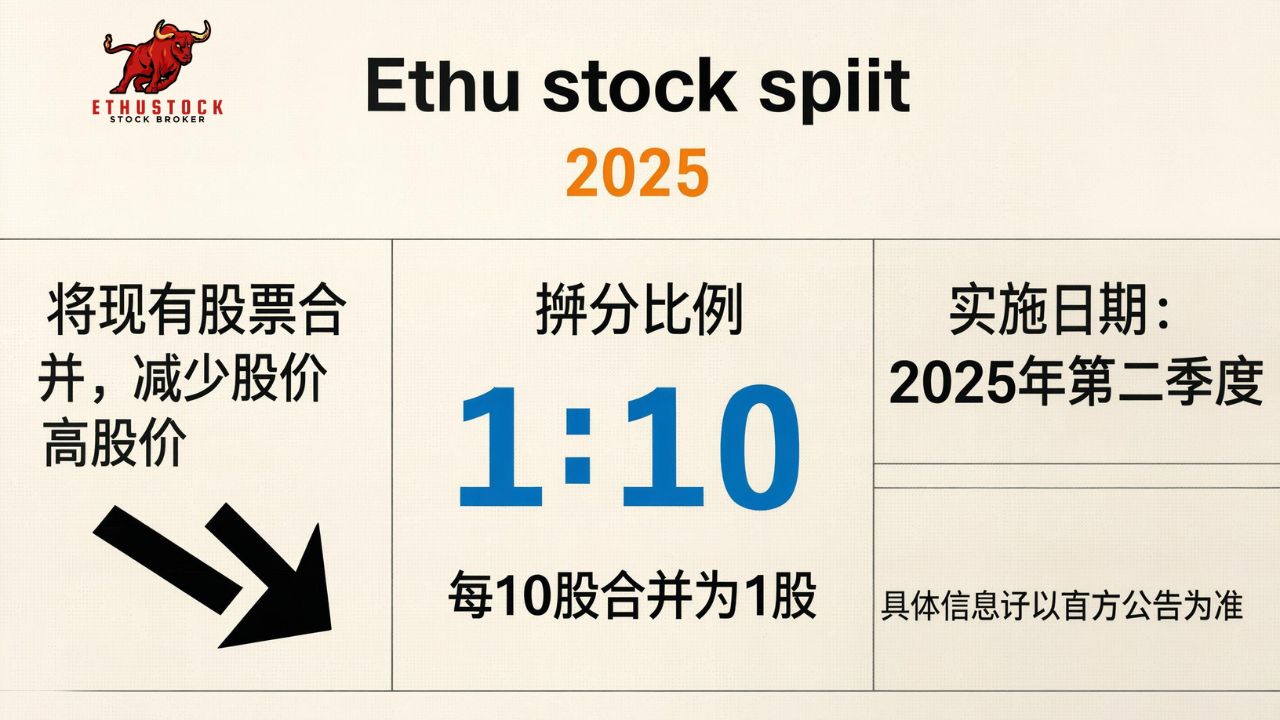
- ETHU executed a 1-for-20 reverse stock split.
- It became effective at the market open on April 9, 2025.
- The ticker stayed ETHU, but the fund received a new CUSIP (92864M798).
If you’re looking up the ethu stock split online, this is the event you’re seeing referenced in SEC disclosures, sponsor materials, and major data providers.
Key facts (official table)
| Item | Detail |
|---|---|
| Action | Reverse stock split |
| Ratio | 1-for-20 |
| Effective date | April 9, 2025 (market open) |
| Ticker change | None (remained ETHU) |
| CUSIP change | 92864M400 → 92864M798 |
| Fractional shares | Redeemed for cash via broker |
Sponsor press release + SEC supplement confirm these points.
Timeline (so you can match it to statements)
| Milestone | Date |
|---|---|
| Board approval mentioned in SEC supplement | March 19, 2025 |
| Sponsor press release dated | March 26, 2025 |
| Reverse split effective (market open) | April 9, 2025 |
The math investors actually need (shares, price, cost basis)
A reverse split is emotionally loud but mathematically simple. With a 1-for-20 reverse split:
- New shares = Old shares ÷ 20
- New price ≈ Old price × 20
A practical example you can mirror to your account
Let’s say you owned 260 shares at $3.50.
- Pre-split position value ≈ 260 × $3.50 = $910
- Post-split shares = 260 ÷ 20 = 13 shares
- Post-split price ≈ $3.50 × 20 = $70
- Post-split value ≈ 13 × $70 = $910 (roughly)
The sponsor’s own illustration shows the same idea: 1,000 shares at a hypothetical $10 NAV becomes 50 shares at a hypothetical $200 NAV—same total value.
Cost basis: what should happen (and what sometimes looks wrong)
In principle:
- Total cost basis stays the same
- Cost basis per share increases by 20×
Example: If you originally invested $910 total:
- Pre-split basis per share: $910 ÷ 260 = $3.50
- Post-split basis per share: $910 ÷ 13 = $70
What can look “off” for a few days:
- Broker cost basis updates lag behind corporate actions
- Fractional share cash adjustments create small realized gains/losses
- Some tax lots display as “unknown” until the broker refreshes records
Fractional shares and “cash in lieu”
If your share count wasn’t a perfect multiple of 20, you would end up with a fractional entitlement.
ETHU’s sponsor states that post-split fractional shares are redeemed for cash and sent to the broker of record—and that this redemption may be taxable.
This is where investors often feel like the split “changed value,” because they see:
- a small cash credit, and/or
- a tiny realized gain/loss line item
To be clear: the reverse split itself is generally not the taxable trigger people imagine; the cash-in-lieu piece is the part that commonly creates a reportable event.
Image 2 (Infographic)
Suggested infographic: “How the 1-for-20 reverse split works” — 3 panels (Before → Conversion → After), plus a small callout: “Not a multiple of 20? You may receive cash in lieu.”
What to expect inside your brokerage (orders, charts, statements)
This is where most confusion happens—because you’re not just dealing with math. You’re dealing with systems.
1) Open orders are often canceled on reverse splits
Many investors get surprised when their limit orders vanish.
Regulators and exchange procedures commonly require that pending orders be canceled for reverse splits. FINRA Rule 5330 explicitly states: when a pending order involves a security subject to a reverse split, the order shall be canceled.
Practical takeaway:
If you had a GTC limit sell, stop, or bracket order on ETHU before April 9, 2025, don’t assume it “carried over.” Check your order history and re-enter orders using post-split pricing.
2) Charts get split-adjusted (and that’s good)
After a reverse split, most charting platforms show split-adjusted history. That means older prices are retroactively scaled so the chart doesn’t look like a vertical cliff.
This is normal and helpful for analysis—just be aware you may be looking at adjusted prices, not raw historical prints.
3) Your statement may show multiple line items
Around a reverse split, it’s common to see:
- “Share consolidation” / “reverse split” entry
- New CUSIP/security identifier behind the scenes
- Cash-in-lieu credit (if applicable)
If you’re reconciling performance, compare:
- total value before vs after (same day), and
- your adjusted cost basis a week later, once systems finalize.
4) Options behave differently (deliverables get adjusted)
If you traded ETHU options (or you’re looking at older options history), reverse splits typically trigger contract adjustments.
Educational guidance from the options industry explains that for a 1-for-20 reverse split, option contracts are commonly adjusted by changing the deliverable (for example, to 5 shares of the post-split security), while the contract multiplier generally remains 100—plus an adjusted symbol.
Exchange notices around ETHU’s event also discussed the corporate action and symbol adjustments on the options side.
Why ETHU did a reverse split (the practical reasons)
A reverse split often triggers negative emotions because people associate it with struggling companies. But ETFs—especially leveraged ETFs—do this for more operational reasons.
1) To keep price in a “convenient” trading range
Fund documents note that price adjustments can be done to maintain convenient trading ranges.
For many platforms, very low prices can cause:
- larger percentage spreads (trading friction)
- messy position sizing (too many shares for modest exposure)
- increased likelihood of order-entry errors
2) Leveraged products can drift lower fast after volatility
ETHU is designed for daily 2× exposure and is described by the sponsor as a product that is not suitable for all investors, intended for knowledgeable investors who actively monitor positions—potentially daily.
In severe drawdowns, leveraged exposure can compress share price quickly. A reverse split doesn’t change the strategy—it just “resets” the unit price.
3) Back-office clarity (CUSIP change)
The sponsor’s press release explicitly notes the new CUSIP after the reverse split.
This helps the financial plumbing distinguish pre- vs post-split shares and reduces downstream reporting errors.
Trading + risk reality for a daily 2x Ether ETF
A lot of people search ethu stock split because something changed in their account, but the bigger long-term driver is the fund’s daily leverage mechanics.
Daily leverage is not “2× over months”
ETHU seeks 2× daily results, not 2× quarterly or annual results. The sponsor is direct about compounding consequences and the need for active monitoring.
That means two investors can buy the same ETF, hold the same number of days, and get meaningfully different outcomes depending on the path Ether took.
Compounding example (simple, but revealing)
Imagine Ether does this over two days:
- Day 1: +10%
- Day 2: -9.09% (so Ether ends back at roughly flat overall)
A daily 2× product roughly targets:
- Day 1: +20%
- Day 2: -18.18%
Your two-day result is not “flat.” It’s:
- Start 100 → Day 1 becomes 120
- Day 2: 120 × (1 – 0.1818) ≈ 98.18
That “volatility drag” is why daily leveraged products can underperform intuitive expectations in choppy markets—even if the underlying is roughly unchanged.
Fees and friction matter more in leveraged funds
ETHU’s product page lists management fees and a total expense ratio (and provides fund data like NAV, shares outstanding, spreads, etc.).
Because leveraged crypto-linked ETFs may rebalance frequently and rely on futures exposure, costs are not just a footnote—they can materially impact long-run holding outcomes.
Risk management that actually fits this product
If you trade ETHU (rather than long-hold it), consider structure that matches the instrument:
- smaller position sizes (because daily swings can be brutal)
- predefined exit rules (time-based exits can be cleaner than emotional exits)
- avoid “set and forget” stops around corporate actions (orders can be canceled on reverse splits)
- treat it as a tactical exposure tool, not a retirement-core holding (consistent with sponsor positioning)
Sponsor background + key fund stats to know
There isn’t a meaningful “personal net worth” angle here (this is an ETF), but sponsor credibility and fund structure still matter.
About Volatility Shares (background)
In the reverse split announcement, Volatility Shares describes itself as:
- a commodity pool operator registered with the National Futures Association (NFA), and
- a registered investment adviser with the SEC.
Fund specifics investors routinely check
ETHU’s product page provides a dense “fund dashboard” style set of stats—useful for sanity checks and due diligence (NAV, net assets, shares outstanding, spreads, and fee/expense details).
A practical way to use this:
- If your broker’s “price” looks odd, compare broker market price vs sponsor page NAV/premium-discount.
- If your share count looks odd after corporate actions, compare shares outstanding trend and corporate action dates.
Image 3 (timeline graphic)
Suggested image: “ETHU key dates” — Launch (Jun 4, 2024) → Board approval (Mar 19, 2025) → Press release (Mar 26, 2025) → Effective reverse split (Apr 9, 2025).
How to verify the split from official sources
Because split info gets copied across the internet (sometimes incorrectly), use a simple reliability ladder:
1) SEC filing supplement (highest confidence)
The SEC supplement explicitly states the 1-for-20 ratio and the effective date (April 9, 2025).
2) Sponsor press release (high confidence)
The press release shows the ratio, the effective timing, and the fractional share cash treatment.
3) Major market data providers (convenient, verify if needed)
Some providers flag the split in historical data (helpful for quick checks).
4) Broker corporate action trackers (practical reconciliation)
Brokers sometimes post a corporate action note explaining the conversion (useful for matching your statement).
FAQ
What was the ratio of the ethu stock split?
ETHU executed a 1-for-20 reverse stock split, effective at the market open on April 9, 2025.
Did the ETHU ticker change after the reverse split?
No. The ticker remained ETHU, but the fund did receive a new CUSIP.
Did the reverse split change my investment value?
At the moment of conversion, a reverse split generally doesn’t change the underlying value—shares decrease while price increases proportionally.
Why did I receive cash after the reverse split?
If your shares weren’t a multiple of 20, you could receive cash in lieu of a fractional share. ETHU’s sponsor states fractional shares are redeemed for cash and routed through the broker, and that it may be taxable.
How does a reverse split affect taxes?
The reverse split itself is usually not the part that surprises investors—cash in lieu can be treated like receiving cash for a fractional share, which can create a capital gain or loss depending on your basis.
Do I need to redo my limit orders or stop losses after a reverse split?
Often yes. Reverse splits commonly cause open orders to be canceled under exchange/regulatory procedures, and you may need to re-enter them at post-split prices.
Is ETHU meant for long-term holding?
The sponsor states ETHU is intended as a short-term trading vehicle and requires active monitoring, potentially daily, due to daily leverage and compounding effects.
Does ETHU hold Ether directly?
No. The sponsor states the fund does not invest directly in Ether and seeks exposure using Ether futures contracts.
Where can I confirm the split from an official source?
Use the SEC supplement and the sponsor’s reverse split press release for the cleanest “source of truth.”
Conclusion
The ethu stock split wasn’t a forward split—it was a clean 1-for-20 reverse split effective April 9, 2025. Mechanically, it reduced share count and raised per-share price without “creating” or “destroying” value at the conversion point. The main practical wrinkle is fractional shares: cash in lieu can show up in statements and may have tax consequences.
If you’re holding or trading ETHU, treat the split as a bookkeeping event and focus your real attention on what actually drives outcomes: daily 2× exposure, compounding behavior in volatile markets, futures-linked dynamics, and total cost/friction.