You’ve probably seen ETHU pop up on a watchlist right when crypto sentiment swings from “this is exciting” to “wait… what did I just buy?” If you’re asking what is ethu stock, you’re already doing the smartest part: slowing down before hitting the button.
Here’s the simple truth: ETHU isn’t “Ethereum stock.” It’s a fund that’s built to amplify Ether’s daily moves—and that “daily” part is where most people get surprised (sometimes pleasantly, often painfully).
In this guide, I’ll break down what ETHU is, what it actually holds, how the 2x leverage works, what it costs, and the exact risks that make it more of a trading tool than a long-term investment.
Table of Contents
- what is ethu stock: the 60-second definition
- ETHU vs Ethereum: what you’re actually buying
- How ETHU gets 2x exposure
- Who runs ETHU? Sponsor background and structure
- Costs, fees, and real-world trading frictions
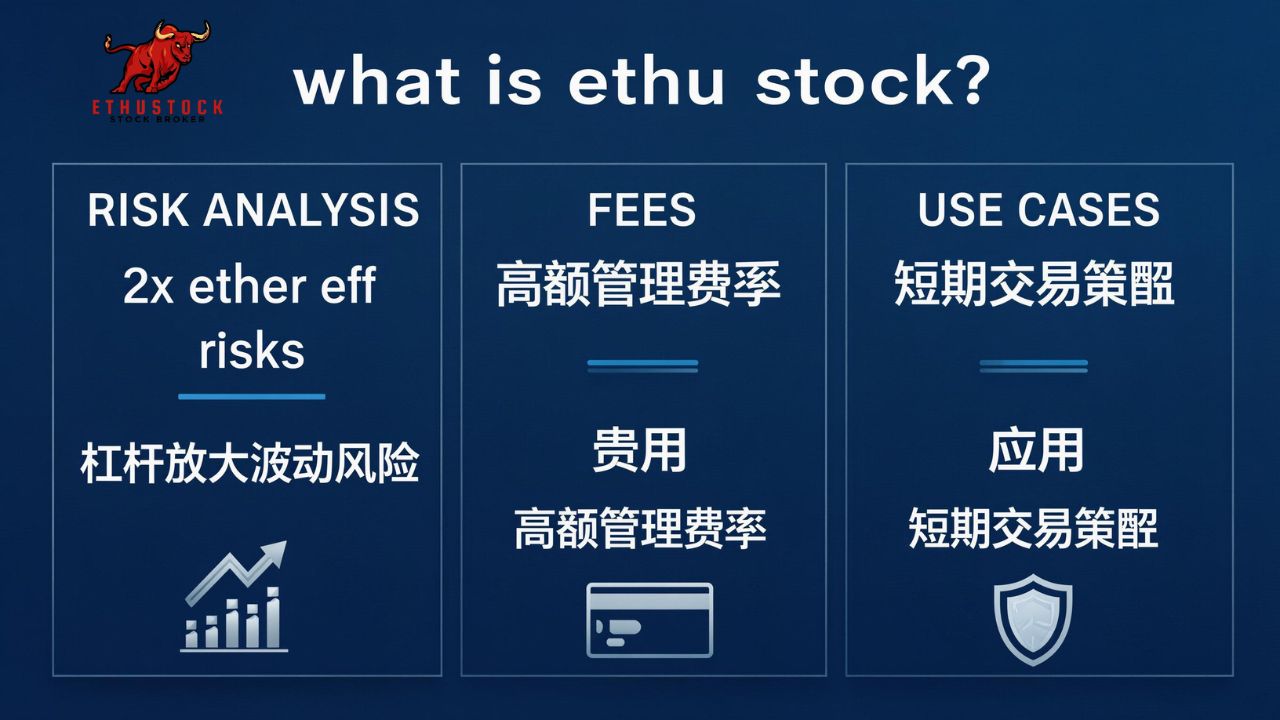
- Risks that matter most with ETHU
- When ETHU can make sense
- ETHU in the real world: examples and scenarios
- ETHU ticker confusion: the U.S. ETF vs Europe’s ETHU
- FAQ
- Conclusion
what is ethu stock: the 60-second definition
ETHU is a leveraged Ether-linked ETF designed to target approximately 2x (200%) of Ether’s daily performance—before fees and expenses. It’s built to track Ether on a one-day basis, not over weeks or months.
That single sentence explains why ETHU can feel thrilling in a strong rally—and brutally disappointing in choppy markets. When price action gets messy, leverage plus daily resetting can create outcomes that don’t match what your gut expects.
So, what is ethu stock really tracking?
In the U.S. context, ETHU (the one most investors mean) is the 2x Ether ETF managed by Volatility Shares and listed on Cboe BZX Exchange. It seeks to deliver twice the daily move of Ether, and it primarily gets that exposure through cash-settled Ether futures (not by holding spot ETH in a wallet).
ETHU vs Ethereum: what you’re actually buying
A lot of people buy ETHU thinking it’s a clean substitute for holding Ether itself. Emotionally, it feels like that—your P&L moves when crypto moves. Mechanically, it’s different.
Here’s the most important distinction:
- Owning ETH (Ether) means you hold the asset directly (typically through an exchange or self-custody).
- Owning ETHU means you own a fund that seeks leveraged exposure, often via futures plus collateral and leverage mechanics.
The difference shows up in three places
- Time horizon: ETHU is engineered for daily results, so multi-day holding can drift in surprising ways.
- Futures behavior: futures can trade differently than spot ETH and require “rolling” over time.
- Leverage math: daily resetting can compound gains or compound damage.
Quick comparison table
| Feature | ETH (spot Ether) | ETHU (2x Ether ETF) |
|---|---|---|
| What you hold | Ether directly | ETF shares seeking 2x daily Ether move |
| Exposure type | Spot | Primarily futures-based, leveraged |
| Best fit | Long-term believers, on-chain users | Short-term traders with strict risk controls |
| Key risk | Volatility, custody/exchange risk | Volatility plus daily-reset compounding risk |
| Can it diverge from ETH over time? | Less (depends on custody/fees) | Yes, often—especially in choppy markets |
How ETHU gets 2x exposure
Let’s demystify the “2x” label, because it’s not magic—it’s math, derivatives, and daily portfolio resets.
Daily reset is the entire game
Most leveraged ETFs are designed to hit their target for one day, then reset exposure for the next trading day. The U.S. Securities and Exchange Commission has repeatedly warned that performance over longer periods can differ significantly from the stated daily multiple—especially in volatile markets.
So if Ether is +5% today, ETHU aims for about +10% today (before fees). If Ether is -5% today, ETHU aims for about -10% today (before fees). Simple, right?
The complication is what happens across many days.
Why multi-day returns can look “wrong”
If Ether chops up and down, the ETF’s daily resets can create volatility drag. Even if ETH ends up flat-ish over a period, a leveraged product can end down meaningfully. This is not a bug; it’s a feature of daily compounding in a volatile sequence.
Futures are usually the engine under the hood
ETHU’s exposure is commonly implemented via cash-settled Ether futures, which are U.S. dollar-settled contracts (you’re not receiving ETH at settlement).
That futures-based design matters because:
- Futures pricing can differ from spot (sometimes subtly, sometimes not).
- Rolling futures introduces costs/benefits depending on the curve (contango/backwardation).
- The fund must manage collateral, margin, and liquidity.
Who runs ETHU? Sponsor background and structure
If you’re researching what is ethu stock, you should also know who the product sponsor is and what the fund is actually promising.
Sponsor and listing details
The official fund materials describe ETHU as the “2x Ether ETF,” with inception in June 2024, traded on Cboe, and structured to seek twice the daily performance of Ether before fees and expenses.
Fund structure in plain language
Many crypto futures ETFs use additional structural components (including offshore subsidiaries in some designs) to hold and manage derivatives efficiently. Public fund profiles describe ETHU as gaining exposure through Ether futures and related instruments rather than holding spot Ether directly.
The practical takeaway: you’re buying a regulated ETF wrapper with market plumbing designed to deliver a specific daily outcome—not a “token in a brokerage account.”
Costs, fees, and real-world trading frictions
Fees may sound boring, but in leveraged products, fees and friction are like sandpaper: subtle day-to-day, brutal over time.
Expense ratio and what it means
ETHU is listed with a total expense ratio around 2.67% (and a management fee shown in official fund details).
That doesn’t mean you lose 2.67% overnight—it’s accrued over time—but it does raise the bar for your trade to work, especially if you hold longer than a short tactical window.
Trading frictions you should expect
- Bid-ask spreads: can widen when crypto volatility spikes.
- Premium/discount to NAV: can happen, especially during fast markets.
- Liquidity variability: volume can be strong on hot days and thinner when sentiment cools.
A practical “cost checklist” table
| Cost / friction | What it is | Why it matters |
|---|---|---|
| Expense ratio | Ongoing annual fund costs | Drags performance, especially if held longer |
| Spread | Difference between buy and sell price | Bigger hidden cost for frequent trading |
| Futures roll | Shifting from expiring contracts to new ones | Can add drag or boost depending on curve |
| Slippage | Worse fills in fast moves | Common in sharp crypto spikes |
| Taxes (potential) | Depends on jurisdiction/account type | Impacts net returns (especially short-term) |
Risks that matter most with ETHU
This is the part people skip when they feel FOMO. Don’t skip it.
1) Daily-reset compounding risk (volatility drag)
The SEC’s investor guidance is blunt: leveraged ETFs “reset” daily and can diverge significantly from the expected multiple over periods longer than a day—especially when markets are volatile.
This is the core risk. It’s also the reason ETHU often works best as a short-term tactical instrument, not a “buy it and forget it” holding.
2) Leverage amplifies emotions—and mistakes
Leverage doesn’t only amplify returns; it amplifies:
- panic selling,
- revenge trading,
- oversized positions,
- and “I’ll just hold until it comes back” thinking.
When ETH moves fast, ETHU moves faster. That can be exhilarating… right up until it isn’t.
3) Futures-specific risks (tracking and roll)
Because ETHU’s exposure is tied to futures, the ETF may not match spot ETH perfectly, even on a single day. Cash-settled Ether futures are a different instrument with their own liquidity, curve, and settlement mechanics.
4) High fee load relative to vanilla ETFs
A ~2.67% total expense ratio is high compared to broad-market ETFs, and that matters more when your holding period stretches.
5) Regulatory and product headline risk
Leveraged ETF products periodically draw extra regulatory scrutiny, especially as the category grows and retail participation rises.
If you only remember one line: what is ethu stock is really “a 2x daily Ether trading tool,” not a long-term ETH replacement.
When ETHU can make sense
ETHU isn’t “good” or “bad.” It’s sharp. Sharp tools can build great things or cause ugly injuries.
ETHU can be rational for:
- Short-term directional views (hours to a few days) when you want amplified exposure.
- Defined-risk setups where you use stop-losses or options overlays.
- Tactical hedging (for advanced users) when managing a broader crypto-linked book.
ETHU is usually a poor fit for:
- Long-term investors who simply want Ethereum exposure.
- Anyone who can’t monitor positions.
- People who “average down” emotionally in high volatility.
A healthy mindset is: “ETHU is for planned trades, not hopeful holding.”
ETHU in the real world: examples and scenarios
Let’s make this feel real.
Scenario A: Trend day (ETH rallies steadily)
- ETH is up consistently across a few sessions.
- ETHU may deliver what you intuitively expect: “roughly double-ish” daily outcomes (fees aside).
In these clean trend windows, ETHU can feel like it’s doing exactly what the label promised.
Scenario B: Chop city (ETH whipsaws)
ETH goes:
- up 6%,
- down 6%,
- up 6%,
- down 6%.
Even if ETH ends near where it started, a daily-reset leveraged product can grind down because losses and gains compound asymmetrically.
This is where people get angry and confused—because the math doesn’t “feel fair.” But it’s consistent.
Scenario C: Big drawdown day
A single brutal down day in ETH can become a double brutal day in ETHU. That’s obvious on paper, but emotionally, it hits different when you see it on your account.
If you don’t have a pre-planned exit rule, leverage tends to turn “I’ll manage risk later” into “I wish I managed risk earlier.”
ETHU ticker confusion: the U.S. ETF vs Europe’s ETHU
Here’s a sneaky issue that trips up even careful investors: ETHU can refer to different products in different markets.
U.S. ETHU (most common “ETHU stock” meaning)
- ETHU = 2x Ether ETF (leveraged, daily target)
Europe/UK listings where “ETHU” may mean something else
In some European venues, ETHU is used as a ticker for a product like the 21Shares Ethereum staking ETP on the London Stock Exchange. That’s a different structure and objective than the U.S. leveraged ETF.
So if you’re researching what is ethu stock, always confirm:
- the exchange,
- the issuer,
- and whether it’s a leveraged ETF or a staking ETP.
This one check can save you from buying the wrong instrument entirely.
FAQ
what is ethu stock used for?
Most traders use it for short-term, high-conviction Ether trades where they want amplified daily exposure, not for long-term holding.
Does ETHU hold Ethereum (ETH) directly?
Typically no. Public descriptions indicate ETHU gains exposure mainly through Ether futures and related instruments, not by holding spot ETH in custody.
Is ETHU a good long-term investment?
For most people, it’s not ideal long-term because daily reset mechanics can cause performance to diverge over time—especially in volatile markets.
What does “2x daily” really mean?
It means the fund targets about twice the percentage move of Ether for that single day, then rebalances to reset leverage for the next day.
What are ETHU’s fees?
Official fund details list a total expense ratio around 2.67% (with management fee details also disclosed).
Can ETHU go to zero?
In theory, extreme moves combined with leverage can cause catastrophic losses. While “zero” is not the base case, leveraged products can suffer very large drawdowns quickly, and they’re not designed for buy-and-hold safety.
Why does ETHU sometimes underperform “2x ETH” over a week or month?
Because daily compounding can create volatility drag, and futures-based exposure can introduce roll and tracking differences versus spot.
Is ETHU the same as an Ethereum staking product?
No. Some tickers labeled ETHU in Europe refer to a staking ETP structure, which is different from the U.S. leveraged ETF and may have different risks/returns.
Where can I confirm which ETHU I’m looking at?
Check the issuer site and the listing exchange. For the U.S. 2x Ether ETF, fund pages and listings on Cboe provide official details like inception date, exchange, and fees.
Conclusion
If you came here asking what is ethu stock, here’s the calm, clear answer: ETHU is a leveraged, daily-reset Ether ETF built for tactical exposure—not a simple proxy for owning Ethereum.
That doesn’t make it useless. It makes it specific. Used with discipline—small sizing, a defined timeframe, and a real exit plan—ETHU can be a powerful way to express a short-term view on Ether. Used casually, it can punish you fast, drain your confidence, and turn a normal crypto swing into a portfolio-level headache.