Introduction
When the economy slows down, paychecks disappear faster than most of us expect. One month, businesses are hiring and expanding. The next, headlines are filled with layoffs and shrinking profits. That sharp shift is often driven by cyclical unemployment, a type of job loss directly linked to the ups and downs of the economy.
Understanding cyclical unemployment isn’t just for economists or policymakers. It matters to workers, business owners, students, and families trying to plan for the future. Whether you’re worried about job security or curious about how recessions unfold, this guide will help you understand what causes these waves of job loss—and what can be done to soften the blow.
What Is Cyclical Unemployment?
Cyclical unemployment refers to job losses that occur because of fluctuations in the business cycle. When economic growth slows or contracts—especially during a recession—businesses reduce production, cut costs, and lay off workers. When the economy recovers, hiring resumes.
In simple terms, this type of unemployment rises during economic downturns and falls during periods of expansion.
It differs from other forms of unemployment because it is not caused by skill mismatches or seasonal patterns. Instead, it is driven by reduced demand for goods and services across the economy.
The Business Cycle Explained
The business cycle typically moves through four phases:
- Expansion – Economic growth, rising employment, increased spending
- Peak – Growth reaches its highest point
- Contraction (Recession) – Output declines, unemployment rises
- Trough – The lowest point before recovery begins
Cyclical unemployment mainly increases during the contraction phase and improves during expansion.
After a few months of declining sales, many businesses begin making difficult decisions. Fewer customers mean fewer shifts, delayed projects, and sometimes complete closures. Entire industries—especially construction, manufacturing, and retail—feel the pressure first.

This pattern has repeated itself throughout modern economic history, from the Great Depression to the 2008 financial crisis and the economic shock during the COVID-19 pandemic.
What Causes Cyclical Unemployment?
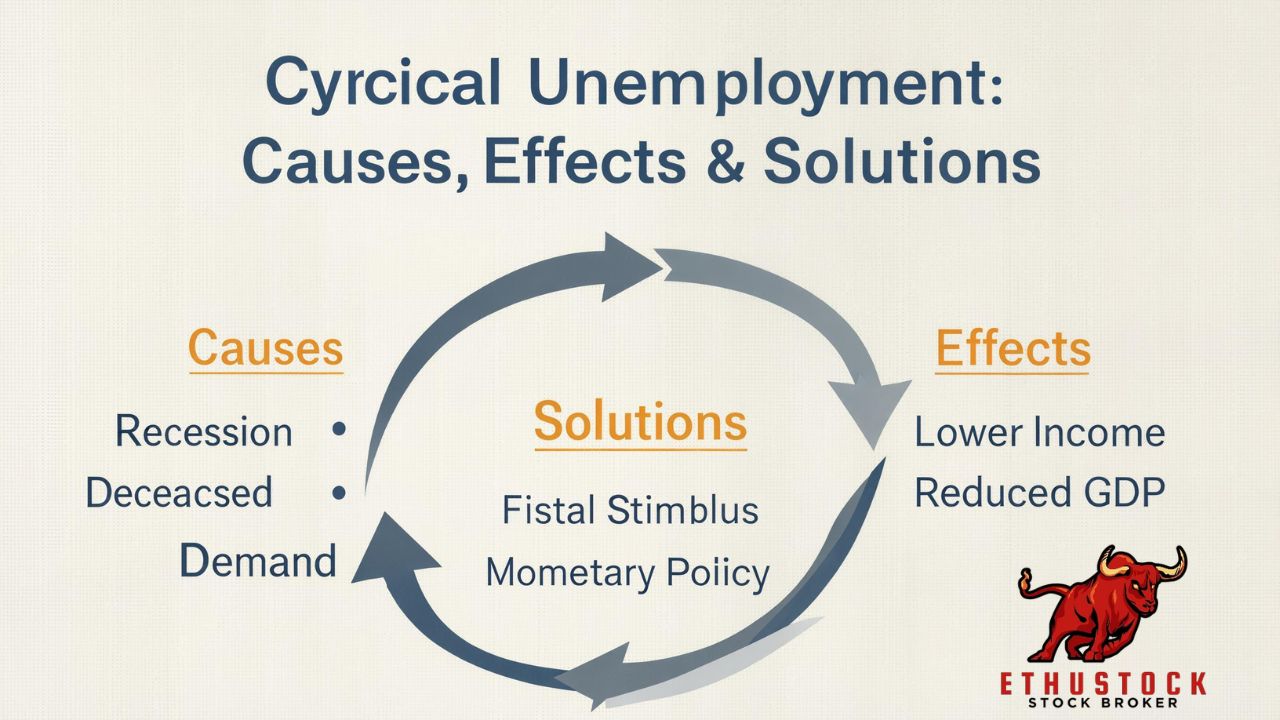
At its core, cyclical unemployment happens when aggregate demand falls. Businesses rely on consumer and business spending. When that spending drops, companies earn less revenue and respond by cutting labor costs.
Several factors can trigger this decline:
1. Economic Recession
A recession is the most direct cause. When GDP shrinks for consecutive quarters, companies experience falling profits and reduce hiring.
2. Financial Crises
Banking collapses or credit crunches limit business investment and consumer borrowing. With less access to money, spending slows dramatically.
3. Reduced Consumer Confidence
If people fear losing their jobs, they spend less. This reduced spending further weakens demand, creating a feedback loop.
4. Decline in Investment
Businesses may delay expansion plans when uncertainty rises. Fewer projects mean fewer jobs.
5. External Shocks
Global pandemics, wars, supply chain disruptions, or commodity price spikes can disrupt economic stability.
When these forces combine, cyclical unemployment increases rapidly.
How Cyclical Unemployment Differs From Other Types
Not all unemployment is created equal. To truly understand cyclical unemployment, it helps to compare it with other categories.
Structural Unemployment
Structural unemployment occurs when workers lack the skills needed for available jobs. For example, automation replacing factory workers.
Frictional Unemployment
This happens when people are temporarily between jobs or entering the workforce.
Seasonal Unemployment
Certain industries, like tourism or agriculture, experience predictable hiring cycles.
Cyclical unemployment, by contrast, affects workers broadly during economic slowdowns—even if their skills match the job market perfectly.
Industries Most Affected by Cyclical Unemployment
Some sectors are more sensitive to economic fluctuations than others.
Construction
Construction is highly dependent on economic growth. When housing demand falls, projects halt and layoffs increase.
Manufacturing
Lower consumer demand means fewer goods produced.
Hospitality and Tourism
Travel and entertainment spending are often reduced first during downturns.
Retail
Consumer confidence plays a huge role in retail employment levels.


White-collar sectors are not immune, but historically, blue-collar and service industries feel the impact sooner.
The Economic Impact of Cyclical Unemployment
The effects go beyond individual workers. When cyclical unemployment rises, the entire economy slows further.
Reduced Household Income
Laid-off workers spend less, decreasing overall demand.
Lower Tax Revenue
Governments collect less income and sales tax during downturns.
Increased Government Spending
Unemployment benefits and stimulus programs increase public expenditure.
Long-Term Skill Erosion
Extended joblessness may weaken skills and reduce future earning potential.
In severe cases, prolonged cyclical unemployment can deepen recessions.
Measuring Cyclical Unemployment
Economists often estimate cyclical unemployment by comparing actual unemployment to the natural rate of unemployment.
The natural rate includes frictional and structural unemployment. When actual unemployment exceeds this level, the difference is often attributed to cyclical factors.
For example:
- Natural rate: 4%
- Actual unemployment: 8%
- Estimated cyclical unemployment: 4%
This method helps policymakers assess the health of the economy.
Government Policies to Reduce Cyclical Unemployment
Governments use two main tools to combat cyclical unemployment: fiscal policy and monetary policy.
Fiscal Policy
Governments increase spending or reduce taxes to stimulate demand.
Examples include:
- Infrastructure projects
- Direct stimulus payments
- Tax cuts
Monetary Policy
Central banks lower interest rates or increase money supply to encourage borrowing and investment.
When borrowing becomes cheaper, businesses invest and consumers spend more.

Well-designed policy responses can shorten recessions and bring workers back into jobs faster.
Real-World Examples of Cyclical Unemployment
History offers powerful examples.
The Great Depression
Unemployment soared above 20% as economic output collapsed.
The 2008 Financial Crisis
Housing market collapse triggered global job losses, particularly in construction and finance.
The COVID-19 Pandemic
Lockdowns caused sudden spikes in cyclical unemployment across travel, hospitality, and retail sectors.
In each case, recovery followed—but the duration and severity varied depending on policy responses.
Who Is Most Vulnerable?
Cyclical unemployment does not affect everyone equally.
Groups often most impacted include:
- Low-income workers
- Temporary and contract employees
- Workers in volatile industries
- Young workers entering the job market
Because these workers often lack financial buffers, economic downturns can have long-lasting effects on their stability.
Can Cyclical Unemployment Be Prevented?
Completely preventing cyclical unemployment is unrealistic because economic cycles are natural. However, its severity can be reduced.
Strong financial systems, diversified economies, and timely policy intervention help cushion downturns.
Investments in education and skill development also improve worker adaptability when industries shrink.
Cyclical Unemployment in a Globalized Economy
Globalization has interconnected economies more than ever before. A financial shock in one country can ripple worldwide.
For example:
- Supply chain disruptions affect multiple regions
- Currency fluctuations influence export demand
- International trade declines reduce manufacturing jobs
This interconnectedness means cyclical unemployment can spread rapidly across borders.
Psychological and Social Effects
Job loss impacts more than income.
Research shows prolonged unemployment may increase:
- Stress and anxiety
- Depression
- Family instability
- Community economic decline
Communities heavily dependent on a single industry may experience lasting hardship during downturns.
FAQ
Frequently Asked Questions
What is cyclical unemployment in simple terms?
It is job loss caused by economic downturns. When businesses earn less revenue, they reduce staff.
How is cyclical unemployment different from structural unemployment?
Cyclical unemployment is caused by economic decline, while structural unemployment happens due to skill mismatches.
Does cyclical unemployment increase during inflation?
Not necessarily. It usually increases during recessions when economic output declines.
Can government spending reduce cyclical unemployment?
Yes. Increased public spending can stimulate demand and create jobs.
Is cyclical unemployment temporary?
Generally, yes. It declines when the economy recovers.
Which industries are most affected?
Construction, retail, hospitality, and manufacturing are often highly sensitive to economic cycles.
How is cyclical unemployment measured?
By comparing actual unemployment to the natural rate of unemployment.
Why does cyclical unemployment matter?
Because it reflects the health of the economy and impacts millions of workers.
Conclusion
Economic ups and downs are part of modern life, but their consequences can feel deeply personal. Cyclical unemployment reminds us how closely our livelihoods are tied to broader economic forces. While recessions may be inevitable, smart policy decisions, diversified industries, and resilient communities can reduce the damage.
By understanding cyclical unemployment, we’re better equipped to prepare for downturns, advocate for effective policies, and make informed financial decisions. Economic cycles will continue—but knowledge gives us an advantage in navigating them.