
Introduction
Every business owner wants one simple answer at the end of the month: How much did we really make? That’s where understanding how to calculate total revenue becomes essential. Whether you run a small online store, manage a service company, or lead a growing startup, revenue is the heartbeat of your financial performance.
When you know how to calculate total revenue accurately, you gain clarity. You can see what’s working, what’s underperforming, and where growth opportunities lie. Without that clarity, you’re guessing instead of deciding.
In this guide, you’ll learn how to calculate total revenue step by step, explore real-world examples, understand common mistakes, and discover how revenue connects to pricing, profit, and long-term strategy. Let’s break it down in a way that’s practical, simple, and genuinely useful.
What Is Total Revenue?
Total revenue is the total amount of money a business earns from selling goods or services before subtracting any expenses.
In simple terms:
Total Revenue = All money earned from sales
It does not account for costs like rent, salaries, materials, or taxes. It only reflects income generated from customers.
For example:
- If you sell 100 units of a product at $20 each
- Your total revenue = 100 × 20 = $2,000
That’s it. Clean and straightforward.
The Basic Formula for Total Revenue
The most common formula is:
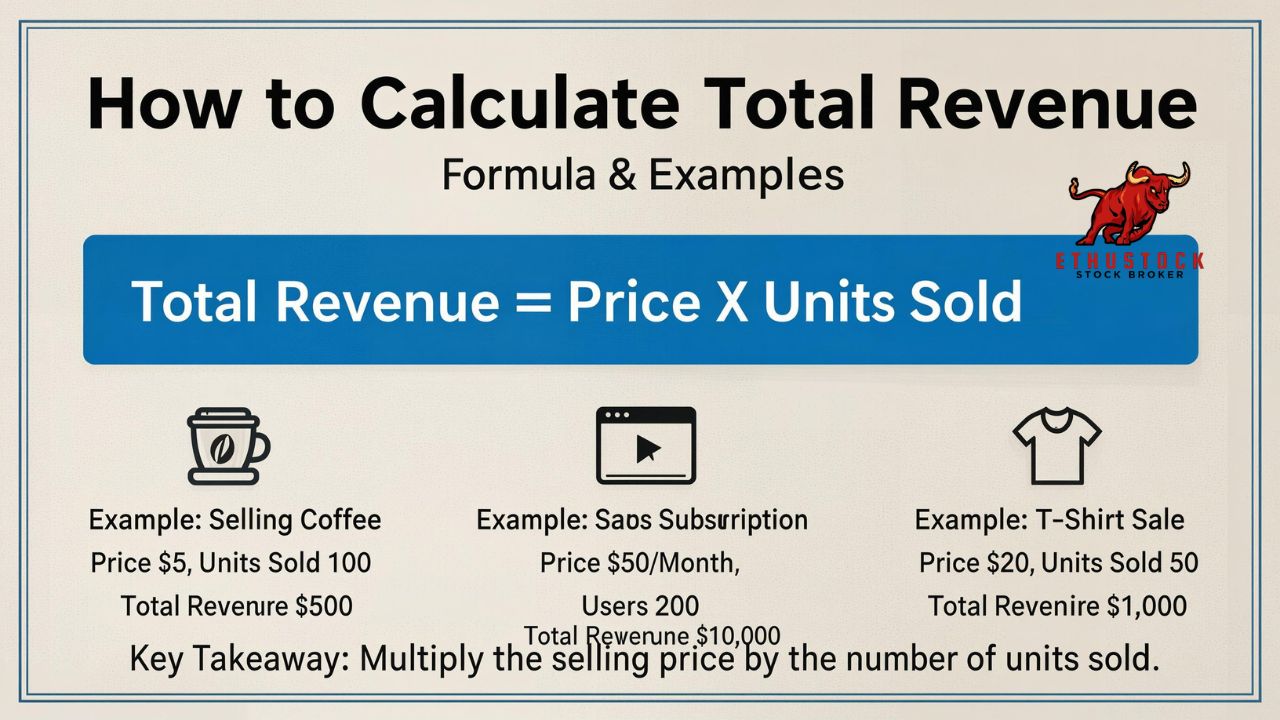
Total Revenue = Price × Quantity Sold
This formula works perfectly for businesses that sell products at a fixed price.
Example 1: Retail Store
- Product price: $50
- Units sold: 200
Total Revenue = 50 × 200 = $10,000
It doesn’t matter what it cost to produce those goods. Revenue only measures incoming sales.

How to Calculate Total Revenue in Different Business Models
Not all businesses sell physical products. Let’s explore variations.
Service-Based Businesses
For service providers, revenue is often:
Hourly Rate × Billable Hours
Example:
- Consultant charges $100/hour
- Works 120 billable hours
Total Revenue = 100 × 120 = $12,000
Subscription Businesses
Revenue becomes:
Subscription Price × Active Subscribers
Example:
- Monthly subscription: $30
- 500 subscribers
Monthly Revenue = 30 × 500 = $15,000
Understanding how to calculate total revenue in these scenarios helps forecast cash flow more accurately.
Gross Revenue vs Net Revenue
Many people confuse total revenue with profit. They are very different.
Gross Revenue (Total Revenue)
Money earned from sales before deductions.
Net Revenue
Revenue after:
- Discounts
- Returns
- Allowances
Example:
- Gross Revenue: $50,000
- Returns: $5,000
- Discounts: $2,000
Net Revenue = 50,000 − 7,000 = $43,000
When learning how to calculate total revenue, always clarify whether you’re working with gross or net figures.

How Pricing Impacts Total Revenue
Revenue isn’t just about selling more. It’s also about pricing correctly.
If you increase price:
- Revenue per unit increases
- But demand may fall
If you lower price:
- You may sell more
- But earn less per unit
Example:
| Price | Units Sold | Total Revenue |
|---|---|---|
| $10 | 1,000 | $10,000 |
| $15 | 800 | $12,000 |
| $20 | 400 | $8,000 |
Notice how revenue peaks at $15 in this scenario.
Understanding how to calculate total revenue allows businesses to test pricing strategies effectively.
Total Revenue in Financial Statements
Revenue appears at the top of the income statement.
That’s why it’s often called the “top line.”
From there, expenses are deducted to calculate:
- Gross profit
- Operating income
- Net profit
Without accurate revenue calculation, every other financial metric becomes unreliable.
How to Calculate Total Revenue With Multiple Products
Many businesses sell different products at different prices.
The formula becomes:
(Price A × Quantity A) + (Price B × Quantity B) + …
Example:
- Product A: $10 × 300 = $3,000
- Product B: $25 × 150 = $3,750
- Product C: $5 × 400 = $2,000
Total Revenue = 3,000 + 3,750 + 2,000 = $8,750
This method is crucial for retail stores and ecommerce businesses.
Revenue vs Profit: Why It Matters
Revenue shows how much money you bring in.
Profit shows how much you keep.
Example:
- Revenue: $100,000
- Expenses: $90,000
- Profit: $10,000
High revenue does not always mean high profitability.
That’s why understanding how to calculate total revenue is just the first step in financial analysis.
Common Mistakes When Calculating Revenue
Even experienced business owners make errors.
Here are common ones:
- Ignoring refunds and returns
- Double-counting transactions
- Mixing revenue with cash flow
- Including tax in revenue totals
- Failing to separate different income streams
Accurate data entry and bookkeeping systems prevent these mistakes.
How Discounts Affect Total Revenue
Discounts reduce revenue per unit.
Example:
- Original price: $100
- 20% discount → New price: $80
- Units sold: 200
Revenue = 80 × 200 = $16,000
Without discount:
Revenue = 100 × 200 = $20,000
That’s a $4,000 difference.
Promotions can increase sales volume—but they must be analyzed carefully.
Revenue Forecasting Basics
To forecast revenue:
- Estimate future sales volume
- Estimate expected price
- Multiply both
Example:
- Expected sales next month: 1,200 units
- Expected average price: $40
Forecast Revenue = 1,200 × 40 = $48,000
Forecasting builds on knowing how to calculate total revenue using historical data.
How to Calculate Total Revenue for Online Businesses
Ecommerce adds complexity due to:
- Shipping fees
- Platform fees
- Returns
- Taxes
However, revenue calculation remains:
Selling Price × Units Sold
Be sure to exclude:
- Sales tax collected
- Refunds
Clarity keeps financial reporting accurate.
Break-Even and Revenue
Revenue also connects to break-even analysis.
Break-even point occurs when:
Total Revenue = Total Costs
If:
- Fixed costs = $20,000
- Price per unit = $50
- Variable cost per unit = $30
Contribution per unit = $20
Break-even units = 20,000 ÷ 20 = 1,000 units
At 1,000 units:
Revenue = 1,000 × 50 = $50,000
Knowing how to calculate total revenue helps determine how much you must sell to survive.
FAQ Section
Frequently Asked Questions
What is the formula for total revenue?
The formula is simple: Total Revenue = Price × Quantity Sold.
Is total revenue the same as profit?
No. Revenue is total sales income before expenses. Profit is what remains after costs are deducted.
Does revenue include tax?
Generally, sales tax collected on behalf of the government is not included in revenue.
How do you calculate total revenue with different prices?
Multiply each product’s price by its quantity sold, then add all results together.
Why is total revenue important?
It measures business performance, supports forecasting, and helps guide pricing strategy.
Can revenue increase while profit decreases?
Yes. If expenses grow faster than sales, profit can shrink despite higher revenue.
How do refunds affect total revenue?
Refunds reduce net revenue and must be subtracted from gross sales totals.
Is revenue the same as income?
In accounting, revenue refers to business sales income. Personal income is broader.
Conclusion
Revenue is more than just a number on a spreadsheet—it’s a signal. It tells you whether your product resonates, whether your pricing makes sense, and whether your business is moving forward or standing still.
Learning how to calculate total revenue gives you control. It transforms vague financial uncertainty into measurable insight. Once you understand revenue clearly, you can improve pricing, manage costs, forecast growth, and build a business that’s not only busy—but profitable.
Master this foundation, and every other financial decision becomes sharper, smarter, and far more strategic.