
Introduction
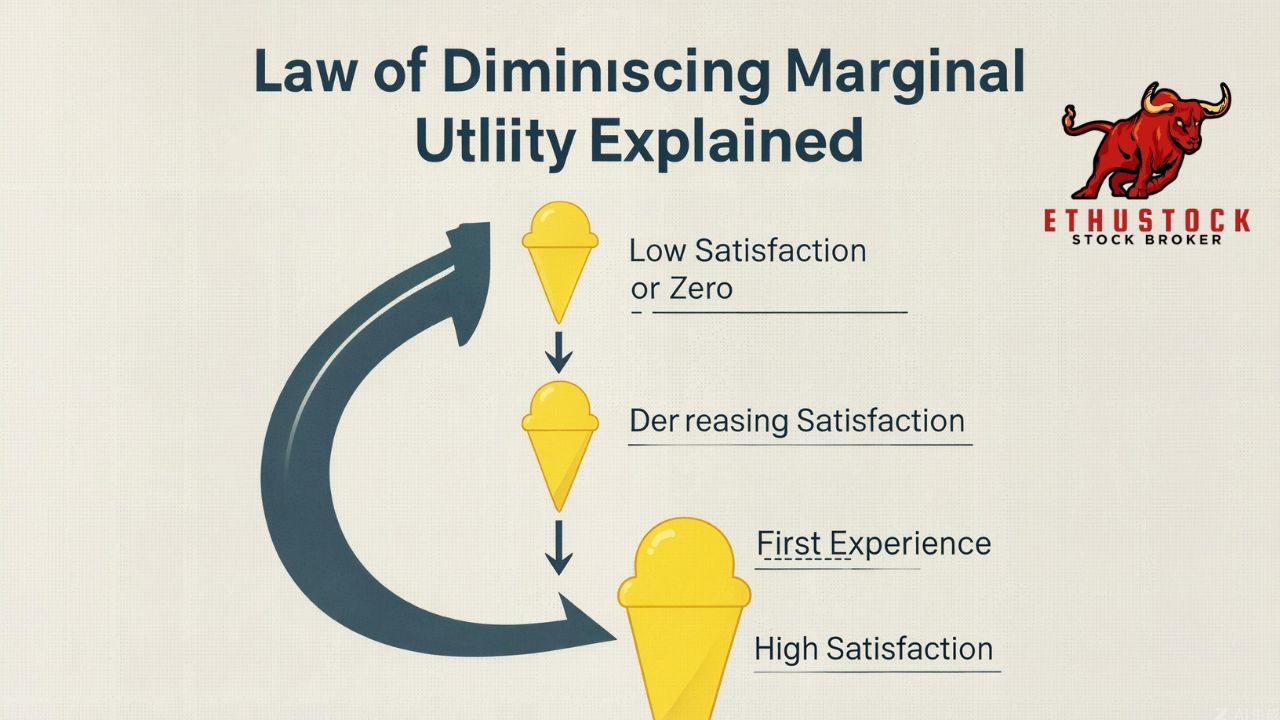
Have you ever noticed how the first slice of pizza tastes incredible, the second is still great, but by the fourth, you’re slowing down? That everyday experience is a perfect example of the law of diminishing marginal utility in action. It’s one of the most fundamental ideas in economics, yet it shows up constantly in real life—far beyond textbooks.
The law of diminishing marginal utility explains why satisfaction decreases as we consume more of the same good. Understanding this principle can transform how you think about spending, pricing, marketing, and even personal decision-making. Whether you’re a student, entrepreneur, investor, or simply someone curious about human behavior, this concept reveals how choices are shaped by changing satisfaction levels.
Let’s unpack it in a clear, practical way—without complicated jargon—so you can see how it influences everyday life and major economic decisions alike.
What Is the Law of Diminishing Marginal Utility?
The law of diminishing marginal utility states that as a person consumes additional units of a good or service, the extra satisfaction (or utility) gained from each additional unit decreases, holding all other factors constant.
In simpler terms:
The more you have of something, the less extra happiness you get from having even more of it.
Understanding Utility and Marginal Utility
Before going further, we need to define two key terms:
- Utility: The satisfaction or benefit a consumer receives from consuming a good or service.
- Marginal Utility: The additional satisfaction gained from consuming one more unit of a good.
For example:
- First bottle of water when you’re thirsty → Very high satisfaction
- Second bottle → Less satisfaction
- Third bottle → Even less
Historical Background and Economic Foundations
The concept was developed during the 19th-century “Marginal Revolution” in economics. Key economists like William Stanley Jevons, Carl Menger, and Léon Walras reshaped economic theory by focusing on individual decision-making rather than labor-based value theories.
They argued that value does not come from how much labor went into a product, but from how much satisfaction consumers gain from it. This shift changed economics forever and laid the foundation for modern microeconomics.
The law of diminishing marginal utility became central to explaining:
- Consumer demand
- Pricing strategies
- Market equilibrium
- Consumer surplus
It also helped solve the famous “diamond-water paradox.” Water is essential, yet cheap. Diamonds are non-essential, yet expensive. Why? Because the marginal utility of water is low (abundant supply), while the marginal utility of diamonds is high
Law of Diminishing Marginal Utility Explained with Examples
Understanding theory is helpful, but real-life examples make it powerful.
Example 1: Food Consumption
Imagine you haven’t eaten all day.
- 1st burger → Extremely satisfying
- 2nd burger → Still good
- 3rd burger → Less enjoyable
- 4th burger → You feel uncomfortable
Each additional burger gives less satisfaction than the previous one.
Example 2: Salary Increases
A raise from $1,000 to $2,000 per month dramatically changes living standards.
But a raise from $100,000 to $101,000? The added satisfaction is much smaller.
Example 3: Streaming Subscriptions
The first streaming platform feels exciting. The second adds value. The fourth? You barely use it.
The law of diminishing marginal utility operates quietly in almost every consumption decision.
Graphical Representation
Economists represent this principle with a downward-sloping marginal utility curve.
As quantity increases:
- Total utility increases (at a decreasing rate)
- Marginal utility decreases
Eventually:
- Marginal utility becomes zero
- After that, it may become negative
This downward slope visually explains why demand curves also slope downward: consumers are willing to pay less for additional units because they gain less satisfaction from them.
Why the Law of Diminishing Marginal Utility Matters
This concept isn’t just academic—it drives real economic behavior.
1. Explains Consumer Demand
Consumers buy more only if prices fall, because additional units give less satisfaction. That’s the foundation of demand curves.
2. Guides Pricing Strategies
Businesses use this principle to:
- Offer bulk discounts
- Bundle products
- Use tiered pricing
3. Influences Marketing Psychology
Limited editions increase perceived marginal utility. Scarcity keeps satisfaction high.
4. Impacts Public Policy
Progressive taxation is partly justified by this concept. The marginal utility of money decreases as income rises, meaning higher earners lose less satisfaction from taxation compared to lower earners.
Assumptions Behind the Law
For the law of diminishing marginal utility to hold, economists assume:
- Units consumed are identical
- Consumption occurs continuously
- Consumer preferences remain constant
- No significant time gap between consumption
If these conditions change, the pattern may vary.
Exceptions and Limitations
While powerful, the law is not universal in every situation.
1. Collectibles and Rare Goods
Some goods may increase in desirability as you acquire more—especially rare items.
2. Addictive Goods
Addictions may distort satisfaction patterns.
3. Complementary Goods
The utility of one good may increase when paired with another.
Still, in most ordinary consumption scenarios, the principle strongly applies.
Relationship Between Law of Diminishing Marginal Utility and Demand
The law of diminishing marginal utility directly supports the downward-sloping demand curve.
When marginal utility decreases:
- Consumers are willing to pay less for additional units
- Price must fall for quantity demanded to increase
This connection forms the backbone of modern microeconomics.
Business Applications
Companies actively use this principle in strategic decisions.
Price Discrimination
Airlines charge different prices because different consumers experience varying marginal utility for seats.
Loyalty Programs
Points systems reset perceived satisfaction, encouraging repeated purchases.
Product Differentiation
Adding features can temporarily raise marginal utility, delaying its decline.
Behavioral Economics Perspective
Modern behavioral economics suggests that satisfaction is not purely mathematical. Emotions, expectations, and social influence shape perceived utility.
For example:
- Luxury branding maintains high marginal utility through exclusivity.
- Social media “likes” follow diminishing satisfaction patterns.
The law of diminishing marginal utility still applies—but perception plays a powerful role.
Frequently Asked Questions
FAQs
What is the simple definition of law of diminishing marginal utility?
It states that as consumption increases, the additional satisfaction gained from each extra unit decreases.
Why is the law of diminishing marginal utility important?
It explains consumer demand, pricing decisions, and market behavior.
Does diminishing marginal utility apply to money?
Yes. The more income a person earns, the less additional satisfaction they gain from each extra dollar.
Can marginal utility become negative?
Yes. When consumption exceeds satisfaction, additional units may create discomfort.
How does this law relate to demand?
It supports the downward-sloping demand curve because consumers value additional units less.
Are there exceptions to this law?
Rare goods, addictive products, and complementary goods may show variations.
Who introduced the concept?
It was developed during the 19th-century Marginal Revolution by economists like Jevons and Menger.
Is this law still relevant today?
Absolutely. It influences business strategy, pricing models, and consumer psychology.
Conclusion
The law of diminishing marginal utility is one of the simplest yet most powerful ideas in economics. It explains everyday behavior—from overeating to spending habits—and shapes global market systems.
By understanding how satisfaction changes with each additional unit, you gain insight into smarter financial decisions, better marketing strategies, and deeper awareness of human behavior. The more you recognize its patterns in real life, the clearer economic logic becomes.
Sometimes, knowing when “enough is enough” is the smartest decision of all.