
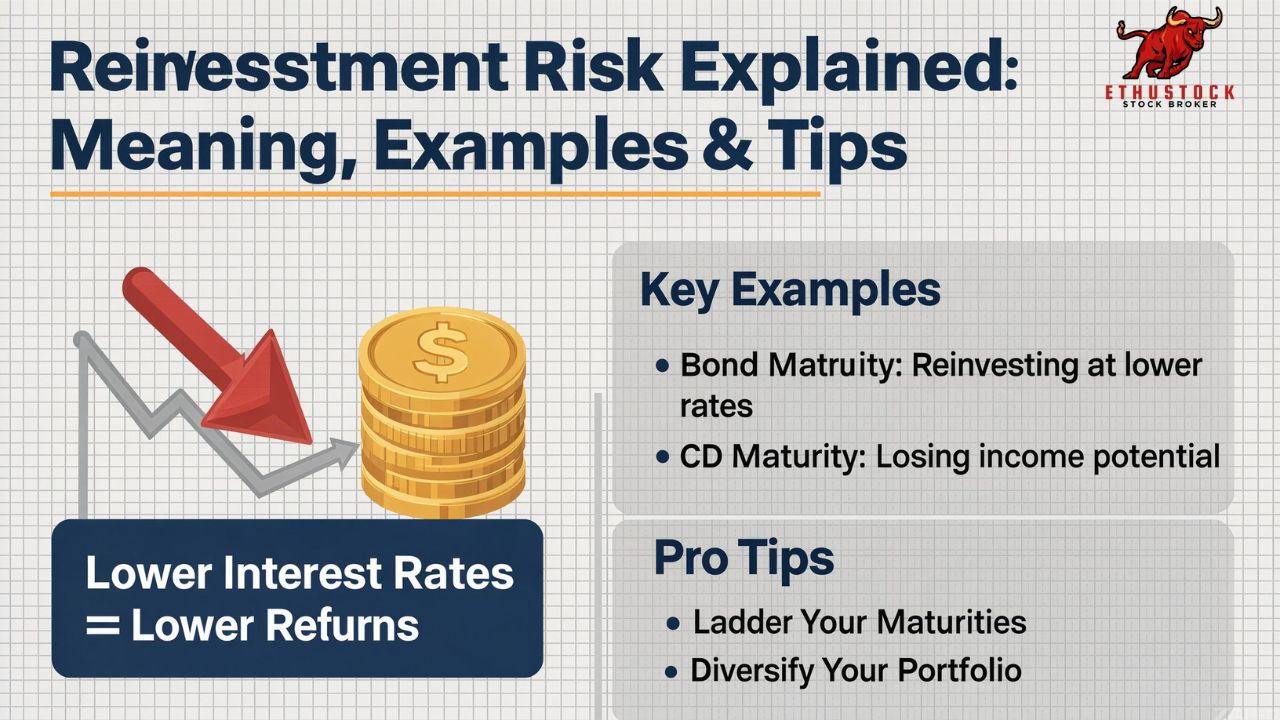
Introduction
Imagine investing in a bond that promises steady income for years—only to discover later that the interest payments you receive can’t be reinvested at the same attractive rate. That frustrating scenario is exactly what investors face with reinvestment risk, a hidden challenge that can quietly reduce long-term returns.
In simple terms, reinvestment risk refers to the possibility that future cash flows from an investment—like bond coupons or dividends—will have to be reinvested at lower interest rates. While it may sound technical, this concept plays a crucial role in how much money investors ultimately earn.
For anyone building a bond portfolio, planning retirement income, or managing long-term investments, understanding reinvestment risk is essential. It influences decisions about bonds, fixed-income strategies, and even dividend-paying stocks.
In this guide, we’ll explore how reinvestment risk works, why it matters, real-world examples, and practical strategies investors use to reduce its impact.
Understanding Reinvestment Risk
Reinvestment risk refers to the possibility that an investor will have to reinvest income or principal from an investment at a lower rate of return than the original investment.
This situation usually arises when interest rates fall. Investors receive periodic payments—such as bond coupon payments—but when they attempt to reinvest those funds, the available investments offer lower yields.
Simple Definition
Reinvestment risk occurs when:
- Interest rates decline
- Cash flows from investments must be reinvested
- New investments offer lower returns
This means the total return from an investment could be lower than originally expected.
Why It Matters for Investors
For long-term investors, reinvestment risk can significantly affect overall portfolio performance. Even if an investment appears safe, declining interest rates can reduce the reinvestment potential of future payments.
For example:
- Bond investors rely on coupon payments
- Retirees rely on fixed-income income streams
- Portfolio managers depend on predictable yields
If reinvestment opportunities drop, income expectations can change dramatically.
How Reinvestment Risk Works in Bond Investments
Bonds are the financial instruments most commonly associated with reinvestment risk because they generate periodic coupon payments.
Bond Cash Flow Structure
A typical bond produces two types of cash flows:
- Coupon payments (periodic interest)
- Principal repayment at maturity
When investors receive coupon payments, they often reinvest them to compound returns.
However, if interest rates decline after purchasing the bond, those reinvested payments may earn less than the original bond yield.
Example of the Process
Suppose you buy a bond with:
- Face value: $10,000
- Coupon rate: 6%
- Annual coupon: $600
If interest rates fall to 3%, the $600 payments may only earn 3% when reinvested.
Over time, this reduces the total return compared with the original expected yield.
Why Long-Term Bonds Are Sensitive
Longer-term bonds create more coupon payments over time, increasing exposure to reinvestment uncertainty.
That means:
- More payments must be reinvested
- More exposure to changing interest rates
- Greater uncertainty in final investment returns
Key Causes of Reinvestment Risk
Several economic factors can lead to reinvestment risk in financial markets.
1. Falling Interest Rates
The most common cause occurs when central banks lower interest rates.
Lower rates mean:
- Newly issued bonds offer smaller yields
- Existing coupon payments earn less when reinvested
2. Early Bond Redemption
Callable bonds can be redeemed before maturity. When this happens, investors receive their principal back early and must reinvest it, often at lower rates.
3. Market Liquidity Changes
Sometimes, market conditions reduce the availability of attractive investment opportunities, forcing investors to accept lower returns.
4. Economic Policy Shifts
Central bank policies—such as those from the Federal Reserve or other monetary authorities—can dramatically affect interest rates and reinvestment options.
Real-World Examples of Reinvestment Risk
Understanding real examples makes the concept easier to grasp.
Example 1: Government Bond Investment
An investor buys a 10-year government bond with a 5% yield.
Five years later, interest rates drop to 2%. The investor continues receiving coupon payments but can only reinvest those funds at the lower rate.
This reduces the bond’s effective overall return.
Example 2: Callable Corporate Bonds
Corporate bonds often include call provisions. If interest rates decline, companies may redeem older high-interest bonds and issue new ones at lower rates.
Investors then face the challenge of reinvesting at lower yields.
Example 3: Retirement Income Portfolio
A retiree depends on bond income. If interest rates fall significantly, reinvesting matured bonds or coupon payments becomes difficult, reducing retirement income over time.
Investments Most Affected by Reinvestment Risk
Some investment types face greater reinvestment exposure than others.
Bonds
Traditional bonds generate periodic interest payments, which must be reinvested.
Callable Bonds
These bonds can be redeemed early, increasing reinvestment uncertainty.
Mortgage-Backed Securities
Homeowners may refinance mortgages when interest rates drop, leading to early principal payments that investors must reinvest.
Dividend-Paying Stocks
Dividend income can also face reinvestment challenges when market yields decline.
Summary Table
| Investment Type | Exposure Level | Reason |
|---|---|---|
| Government Bonds | Moderate | Regular coupon payments |
| Corporate Bonds | High | Callable features |
| Mortgage Securities | High | Prepayment risk |
| Dividend Stocks | Low–Moderate | Dividend reinvestment |
Strategies to Reduce Reinvestment Risk
Investors cannot eliminate reinvestment risk entirely, but several strategies help manage it effectively.
1. Bond Laddering
Bond laddering involves purchasing bonds with different maturity dates.
Benefits include:
- Regular principal returns
- Flexibility in reinvestment timing
- Reduced exposure to single interest-rate environments
2. Zero-Coupon Bonds
Zero-coupon bonds do not make periodic payments.
Instead, they are purchased at a discount and mature at face value. Since there are no interim payments, reinvestment risk is minimized.
3. Diversification
Diversifying across asset classes can help balance interest rate changes.
Example diversification mix:
- Bonds
- Dividend stocks
- Real estate investment trusts
- Treasury securities
4. Shorter Maturity Bonds
Short-term bonds reduce exposure because investors regain principal faster and can adapt to changing market conditions.
5. Reinvestment Planning
Active portfolio management can help investors reinvest payments strategically when market opportunities arise.
Reinvestment Risk vs Interest Rate Risk
These two concepts are closely related but not identical.
Interest Rate Risk
Interest rate risk refers to changes in bond prices caused by fluctuations in interest rates.
When interest rates rise:
- Bond prices fall
- Investors holding bonds may face losses if they sell early.
Reinvestment Risk
Reinvestment risk focuses on the return earned when reinvesting income from an investment.
When rates fall:
- Coupon payments earn less
- Overall investment returns decline
Comparison Table
| Risk Type | Impact | When It Occurs |
|---|---|---|
| Interest Rate Risk | Changes bond price | When rates rise |
| Reinvestment Risk | Reduces reinvestment returns | When rates fall |
Both risks often occur together, making interest-rate environments particularly challenging for fixed-income investors.
Role of Reinvestment Risk in Portfolio Management
Professional portfolio managers pay close attention to reinvestment dynamics when managing large fixed-income portfolios.
Portfolio Yield Planning
Fund managers calculate expected yield assuming that coupon payments are reinvested at a certain rate.
If reinvestment conditions change, portfolio income projections must be adjusted.
Asset Allocation Decisions
Investment professionals may allocate funds across different assets to balance reinvestment exposure.
Typical strategies include:
- Mixing bonds with equities
- Including inflation-protected securities
- Holding global fixed-income assets
Long-Term Financial Planning
Financial advisors often model reinvestment assumptions when planning retirement income streams.
Even small changes in reinvestment rates can significantly affect long-term portfolio growth.
Personal Background of Fixed-Income Investing and Financial Growth
The study of reinvestment risk is closely tied to the evolution of modern fixed-income markets.
For decades, economists and financial analysts have studied how interest rate fluctuations influence investment outcomes. The rise of sophisticated bond markets in the late twentieth century led to deeper research into risk management.
Portfolio managers, hedge funds, and institutional investors now rely on advanced financial models to estimate reinvestment outcomes. These models consider:
- Interest rate forecasts
- Inflation expectations
- Yield curve movements
Many successful investment careers in fixed-income management have been built around mastering interest rate cycles and reinvestment strategies.
Professionals in this field often oversee portfolios worth billions of dollars. Their compensation and financial success depend heavily on managing risks like reinvestment risk effectively.
FAQ
What is reinvestment risk in simple terms?
Reinvestment risk is the chance that money received from an investment—such as interest payments—must be reinvested at a lower rate than the original investment.
Why is reinvestment risk important?
It affects the total return investors earn, particularly for bonds and fixed-income investments that generate periodic payments.
Which investments face the highest reinvestment risk?
Callable bonds, mortgage-backed securities, and long-term bonds are typically the most affected.
Does reinvestment risk affect stocks?
It can affect dividend investors because dividends may be reinvested at different market yields.
How can investors reduce reinvestment risk?
Strategies include bond laddering, zero-coupon bonds, diversification, and managing portfolio maturity dates.
Is reinvestment risk the same as interest rate risk?
No. Interest rate risk affects bond prices, while reinvestment risk affects the return on reinvested income.
Do falling interest rates increase reinvestment risk?
Yes. When rates decline, new investment opportunities usually offer lower returns.
Are zero-coupon bonds free from reinvestment risk?
They significantly reduce reinvestment risk because they do not generate interim cash flows.
Conclusion
Understanding reinvestment risk is crucial for anyone investing in bonds or income-producing assets. While it often goes unnoticed, this risk can quietly reduce long-term investment returns when interest rates fall.
By recognizing how reinvestment risk works and adopting smart strategies—such as bond laddering, diversification, and careful reinvestment planning—investors can protect their portfolios and maintain more predictable income streams.
In the ever-changing world of financial markets, managing risks like reinvestment risk isn’t just smart investing—it’s essential for building sustainable wealth over time.